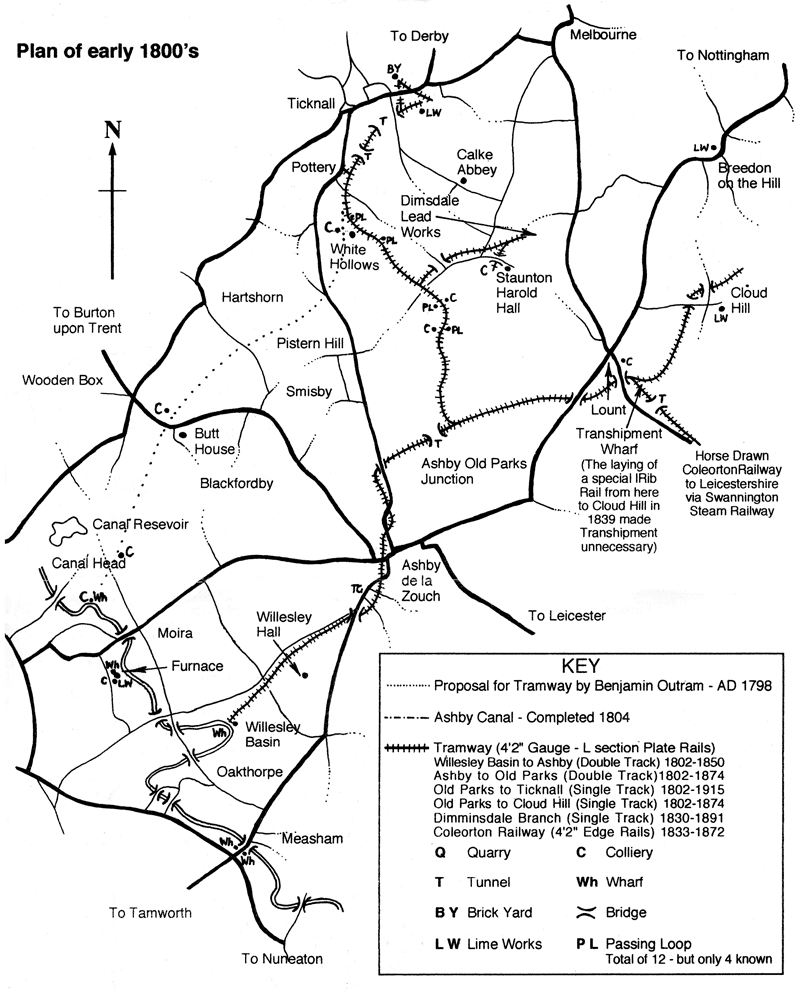
Many traces of the tramroad can still be seen, quite apart from the Ticknall Arch and the tunnels nearby. Some of the stone blocks which served as sleepers to the track are still intact, and here and there, the low embankment on which the tramway ran may still be traced. The standard gauge railway line which replaced the old tramroad in Ashby had a short life by comparison and its passenger train service was taken off long before the days of Dr. Beeching and the wholesale closure of branch lines – in fact in September 1930. Some goods trains continued to run until November 1939, when the line was handed over to the War Department and it became known as the Melbourne Military Railway and was used for the training of Army personnel. It was under military control until the end of 1944 when it was returned to the ownership of the L.M.S. Railway. The goods traffic over the line seems to have gradually disappeared until it only carried the coal from Lount and some stone from Worthington down to Derby. The track has now been lifted all the way.

However, a good deal of the Ashby canal itself still exists, although it opened as long ago as 1804. The railway running parallel with it was not opened until 1873. The colliery at Moira, at the end of the canal, used the railway to some extent but it had its own fleet of boats well into the 20th century. In 1944, carriage of coal on the canal had altogether ceased at Moira and the top three miles of canal from Donisthorpe to Moira were abandoned. At the end of the 1950s there was still a little traffic as far as Measham. The
Not many years ago, we happened to stop near Snarestone in the car one evening as a trading boat came along. It belonged to two enthusiasts who were attempting to revive the carriage of coal on the canal in a small way, loading at a colliery and selling it in villages along the canal. They had not been to Snarestone before and had expected to buy groceries in local shops, but arriving late, they had found that all the shops were closed. We were able to provide them with the remains of our picnic and had an interesting talk with them. Whether their efforts to build up a small coal business prospered, I am afraid I cannot say, but it was remarkable to find the canal still used for the purpose for which it had been intended after so many years.
Geoffrey Holt 1984